
THE PLATFORM
Reputation, measured like any other asset.
Augur is the operating system for corporate reputation. It turns intangibles into numbers leaders can act on—reputation’s economic value, tracked over time, and its movement priced against the market. Not sentiment scores or media mentions. The value of the asset—and early warning when it’s at risk.
Every board knows reputation is among the company's most valuable assets and the least well measured. Augur closes that gap. Built on an insurance-grade methodology for valuing reputation and quantifying reputational risk, the platform gives you a defensible figure for what your reputation is worth, how it's trending, and how much of it is exposed when an issue breaks—the same discipline the market already applies to every other asset on the balance sheet.
Real company reputation value data, anonymized.
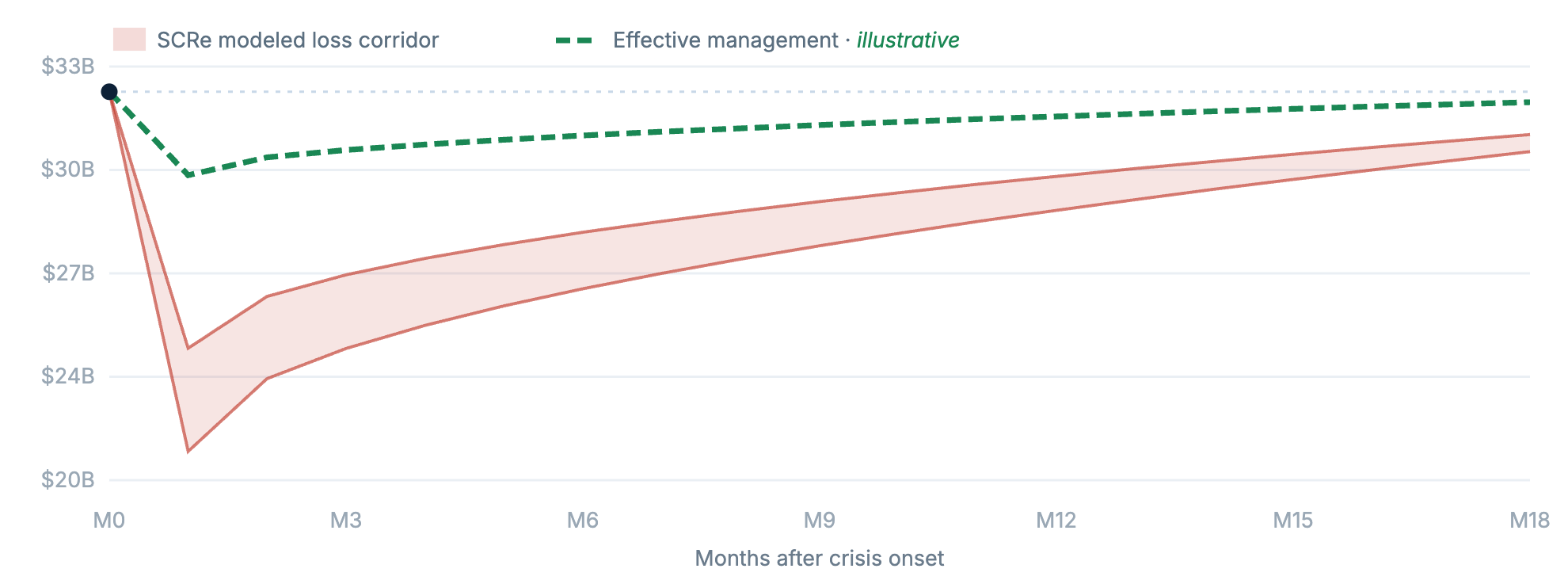
Predictive, real-time model of market cap loss in a crisis—with and without effective mitigation.
Augur is built for:
Chief Communications Officers — to defend budget and strategy in the language the C-suite already speaks: value at stake, value protected, value created.
General Counsel — to quantify reputational exposure in litigation, investigations, and disputes, and to weigh settlement and disclosure decisions against it.
CEOs and Boards — to see, in dollars, whether reputational value is being protected or eroded, and to govern it deliberately rather than in hindsight.
CFOs and Investor Relations — to connect reputation to market performance and tell that story to investors with evidence behind it.
Augur can help you answer:
What is our reputation actually worth today, and which way is it moving?
How much economic value is at risk in this issue — and is it material enough to act on?
If this escalates, how is the market likely to respond?
Is our reputation strengthening or eroding against our peers?
What did that campaign, response, or investment actually protect or create?
Is management doing enough to safeguard reputational value — and can we prove it to the board?
Reputation you can measure is reputation you can defend.
Frequently Asked Questions
We know that Augur offers a different approach to measuring reputation value—especially for communications and marketing teams used to measuring coverage volume and social sentiment. Those metrics are important. They aren’t reputation.
Augur’s reputation measurement doesn't come from media or social data. It comes from our founding data partner, Steel City Re—the insurer that wrote the first reputation risk policies almost three decades ago. They built the metric to underwrite those policies, and that's the part that matters: it had to predict real loss, because they were paying claims against it.
The inputs are financial analysts' forward expectations for a company—purchased from FactSet, updated daily. Steel City Re transforms those into their Reputation Value Metric (RVM). We license it and unbundle it back into the individual stakeholder groups behind it: investors, customers, employees, creditors, suppliers and partners. So you don't just see that reputation value moved, you see which group moved and how firmly they're holding that position.
We deliberately keep media and social data out of the core number. Coverage is the discussion of reputation; it isn't what reputation costs. But your monitoring feed still matters, so we overlay it: your monitoring data sits on top of the reputation curve, so you can see which narrative cycles actually moved value and which ones didn't.
We answered some of our customers’ most frequently asked questions below.
-
We license the core reputation metric from Steel City Re, the insurer that introduced reputation risk insurance roughly twenty-five years ago. The measure was created for underwriting, not for marketing analytics—it exists because someone had to price reputation and then pay out when it was damaged.
-
Financial analysts' forward expectations of company performance, purchased in bulk from FactSet and refreshed daily. These are professional forecasts of reputation’s impact on business performance, not opinions about how a brand is perceived.
-
Steel City Re maintains equity portfolios constructed on the reputation value measure, two of them calculated by Dow Jones and one in-house, which have outperformed the S&P 500 and their peer sets consistently for two decades.
Augur’s own research using Steel City Re data has found that companies with low RVM scores are materially more fragile, suffering 20%+ higher equity losses in all types of crises compared to their high-reputation peers.
-
The RVM correlates with equity value, which is the point—we understand reputation as a slice of enterprise value. But underlying signals map to stakeholder groups, and they often diverge: investors can read negative while customers and employees read positive, or the reverse. That divergence is the actionable part, and it isn't recoverable from a share price.
-
We ingest the composite RVM and unbundle it into its constituent stakeholder signals—investors, customers, employees, creditors, suppliers, and partners—plus a second-order signal we call conviction: how resilient or fragile each of those positions is. A stakeholder group reading positive but holding that position weakly is a materially different risk from one reading positive and holding firm. That distinction is invisible in a composite score.
-
Actuarial methods can tell you what a class of event actually costs base rates, severity, time to recover. Behavioral science tells you the mechanism. Reputation damage isn't a feeling; it's enacted by people making decisions: customers switching, employees leaving, creditors repricing risk, investors selling, partners renegotiating.
Each stakeholder signal we measure is an expectation of business performance mapped onto the behavior that expectation tends to produce. That's the fusion—the behavioral layer explains how value moves, the actuarial layer prices how much.
Media analytics can describe a conversation with real sophistication, but it can't tell you what the conversation costs, because nothing about it was ever priced by someone carrying the risk.
-
No social or media data enters the core reputation value calculation. The MarComms industry has spent decades trying to reconstruct reputation from what stakeholders are saying, which measures the discourse rather than the business consequence. We measure reputation as a component of enterprise value.
Coverage and sentiment remain important context—which is why they're overlaid rather than omitted.
-
In a standard package, reputation value updates weekly; share price, media, and social update daily.
Daily reputation value is technically available and materially more expensive, and in most cases we don't think it's worth it—a single news cycle rarely moves true reputation value inside twenty-four hours. Volatility is the fast-moving signal, and that's the one that leads.
-
We don't replace media monitoring and we don't ask you to. Whatever feed a client already runs—Newswhip, Talkwalker, Meltwater, Cision, a bespoke build—pipes into the Narrative view, where our event-labeling engine isolates the individual narrative cycles (the recall, the breach, the layoffs) and maps them against reputation value movement. The output is an answer to the question every monitoring report dodges: did this cycle move the business, or didn't it?